
What Does Qur’an 17:12 Teach Us About Time and the Measurement of Years?
Browse through our different programs

Browse through our different programs
Recite Quran – Al-Isra’ [17:12]
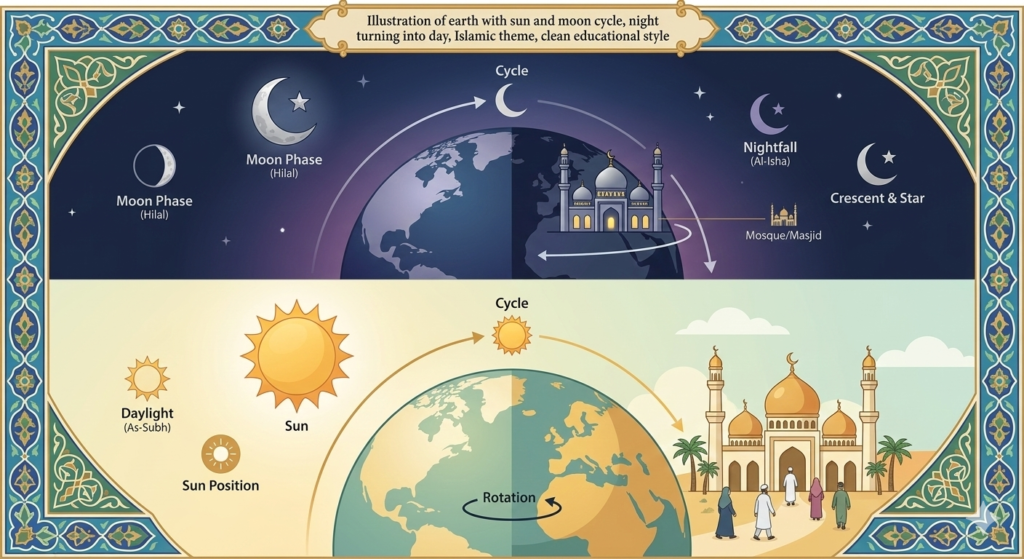
Throughout history, the Qur’an has encouraged believers to reflect on the natural order of the universe. For example, a powerful idea appears in Qur’an 17:12, where night and day are described as signs through which humans can know the number of years and calculation of time.

As a result, Muslim scholars became deeply interested in studying the movement of the heavens, the measurement of time, and the organization of calendars. Over several centuries, this curiosity led to remarkable scientific achievements in astronomy, mathematics, engineering, and geography. The following developments show how this quest to understand time shaped the intellectual legacy of Islamic civilization.
First, Muslim scholars significantly expanded the field of Astronomy. Their goal was not only theoretical knowledge but also practical applications for everyday religious life.
For instance, astronomy helped determine:
Furthermore, several renowned scholars played a major role in advancing astronomical knowledge. Among them were:
These scholars made remarkably accurate calculations of the solar year and lunar cycles.
In fact, Al-Battani calculated the solar year as 365 days, 5 hours, and 46 minutes, which is extremely close to modern scientific measurements.
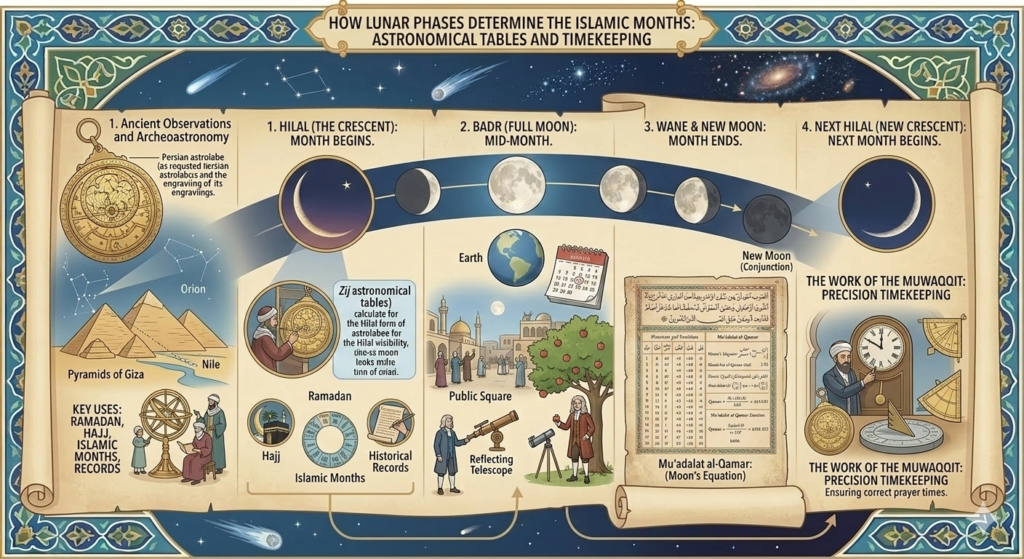
In addition, Muslim scholars refined the Islamic lunar calendar, which plays a central role in Islamic religious life.
This calendar determines the timing of:
Moreover, scholars developed methods to observe and predict lunar phases. These techniques helped determine the beginning and end of months with greater accuracy.
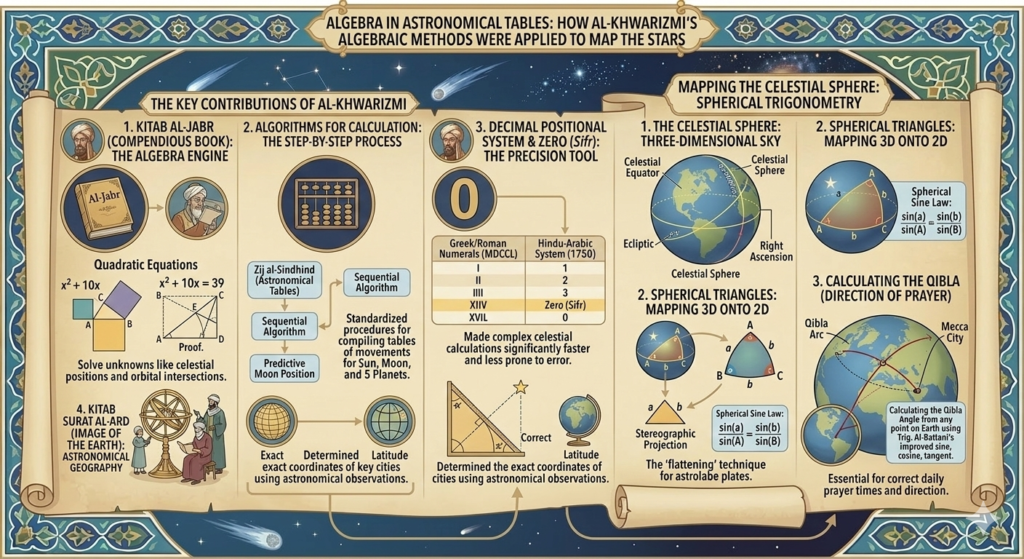
However, accurate astronomical calculations required strong mathematical foundations. Therefore, Muslim scientists made significant contributions to Mathematics.
A key figure in this development was:
Most importantly, his work led to the development of Algebra. His mathematical methods introduced:
As a result, these innovations became essential tools for astronomical calculations and scientific research.
Next, Muslim astronomers compiled detailed scientific records known as Zij, which were astronomical tables used for precise calculations.
Famous examples include:
These tables allowed scholars to calculate:
Consequently, European scientists later used many of these astronomical tables for several centuries.
Meanwhile, Muslim rulers supported scientific research by building large observatories. These institutions served as centers for astronomical observation and education.
Two of the most famous observatories were:
At these observatories, scientists recorded precise star positions, planetary movements, and yearly cycles.
Therefore, these institutions played an essential role in advancing astronomical knowledge during the medieval period.
Alongside theoretical knowledge, Muslim engineers also designed innovative scientific instruments.
One of the most important instruments was the Astrolabe.
This device could determine:
Because of its versatility, the astrolabe became one of the most widely used scientific tools of the medieval world.
Similarly, engineers developed sophisticated timekeeping machines.
For example, the famous engineer Al-Jazari created complex water clocks and mechanical clocks during the 12th and 13th centuries.
These machines were capable of:
In fact, some of these devices are considered early examples of programmable machines.
Furthermore, Muslim scholars developed precise mathematical formulas to calculate the five daily prayers.
This required careful analysis of:
Therefore, the study of prayer times became closely connected with astronomy and mathematics.
Finally, the study of time also contributed to advances in Geography.
For instance, scholars such as Al-Biruni made groundbreaking contributions by calculating:
As a result, these discoveries improved mapping, navigation, and the understanding of the Earth’s structure.
In conclusion, the Qur’anic idea of measuring years and calculating time inspired Muslim scholars to explore the natural world with curiosity and precision.
Consequently, Islamic civilization produced remarkable achievements in:
Overall, these developments played a significant role in shaping global scientific progress and later influenced the scientific revival of Europe during the Renaissance.

Arabic grammar is the key that unlocks deeper understanding of the Qur’an. While learning Arabic may seem difficult…
Read More →
One of the greatest responsibilities Allah has placed upon parents is nurturing love for the Qur’an in the…
Read More →
The Qur’an was revealed in the Arabic language — a language filled with depth, beauty, and precision. Learning…
Read More →